15 Neutral Holiday Decor Ideas for a Calm, Elegant Christmas
Neutral holiday decor is Christmas styling in beige, cream, white, and natural wood — no loud red, no glitter overload — built around texture, candlelight, and greenery. The simplest formula is this: one natural garland, cream velvet ribbon on the tree, and warm white lights everywhere, and your home already feels calm, elegant, and festive.
The Quiet Kind of Festive
There is a particular peace to a house decorated in neutrals at Christmas. It does not shout, it does not flash, and it does not compete with the people in it — it simply glows, quietly, like candlelight through linen. My own turn to neutral holiday decor came the year I took down a tree covered in every colour I owned and realised I felt more festive, not less, with cream ornaments and a plain wooden star on top. The house felt bigger, calmer, and somehow more grown-up, and guests kept saying it felt like a hotel they actually wanted to stay in. That is the spirit behind these fifteen neutral holiday decor ideas: not a bare or boring Christmas, but a layered one — cream velvet, beige ornaments, natural wood, white ceramics, and linen textures doing all the work that colour usually does. Every idea below is one I have tried in my own home, with honest notes on what looked expensive, what looked unfinished, and what I would do differently next year.
1. A Beige and Cream Christmas Tree for Your Neutral Christmas Living Room Decor
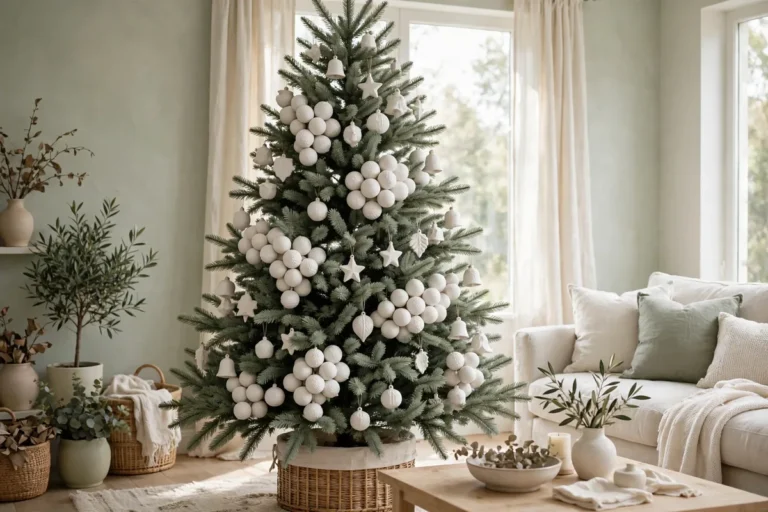
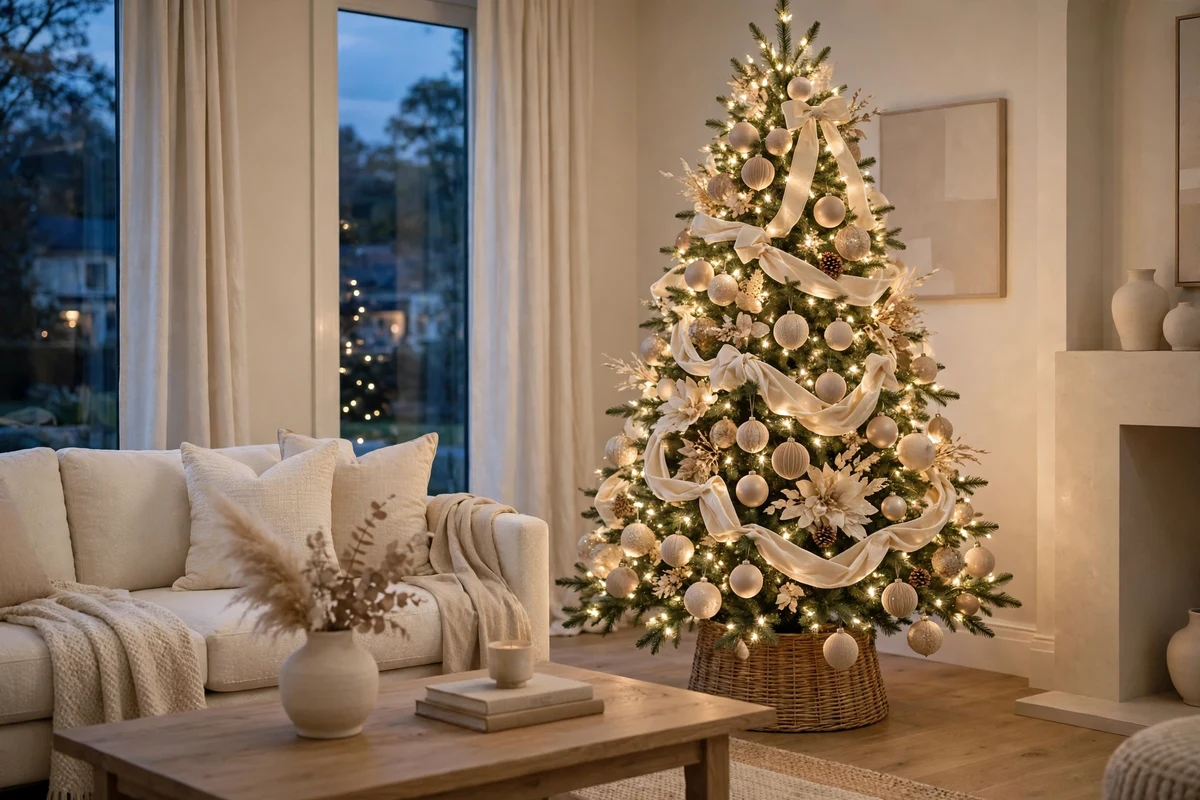
If you try only one of these neutral christmas living room decor ideas, make it a beige and cream tree — because the tree sets the palette for the whole house, and a calm tree makes every other decoration easier. Mine is a full green fir dressed entirely in cream, champagne, and beige: matte baubles, a few glass drops, cream velvet ribbon wound loosely through the branches, and warm white lights. From across the room it glows rather than sparkles, and in the evening, with only the tree lights on, the whole living room feels like a snow globe at rest. It is the tree my friends photograph most, which surprises me every year, because it is the simplest tree I have ever dressed.
Dress yours in layers, not in one pass: lights first, deep inside the branches, then ribbon in long, loose loops, then ornaments largest at the bottom and smallest at the top. I keep the ornament count lower than I used to — about two-thirds of what the tree could hold — because negative space is what makes a neutral tree look elegant instead of sparse. If your living room already leans soft and pale, echoing the same calm with Scandinavian Christmas calm nearby keeps the whole house feeling like one quiet story.
2. Cream Velvet Ribbon Wound Through the Branches
Cream velvet ribbon is the single most transformative neutral decoration I own, because it adds softness and luxury to a tree for the price of a few metres of fabric. Mine is wide — about six centimetres — in a warm ivory, wound through the tree in long, billowing loops rather than tight spirals, with the ends left to trail and curl. It catches the light differently from every angle, it hides the odd bare patch better than any ornament, and it makes a shop-bought tree look like it was dressed by someone who does this for a living. I buy it by the roll now, because I use it on the tree, the mantel, the staircase, and the wreath, and I have never once regretted a metre of it.
Wind yours from the top down, tucking the ribbon deep into the branches every half-metre so it looks woven rather than draped on top. Cut the ends at an angle and let them hang free — a ribbon that ends in a neat bow looks fussy, while a ribbon that trails looks effortless. I use the same ribbon on gifts under the tree, tied in simple knots rather than bows, so the whole corner reads as one intention. If a length gets creased in storage, a quick pass with a cool iron brings it straight back, and I have reused the same rolls for four Christmases now.

3. A Neutral Christmas Mantel With White Ceramic Houses
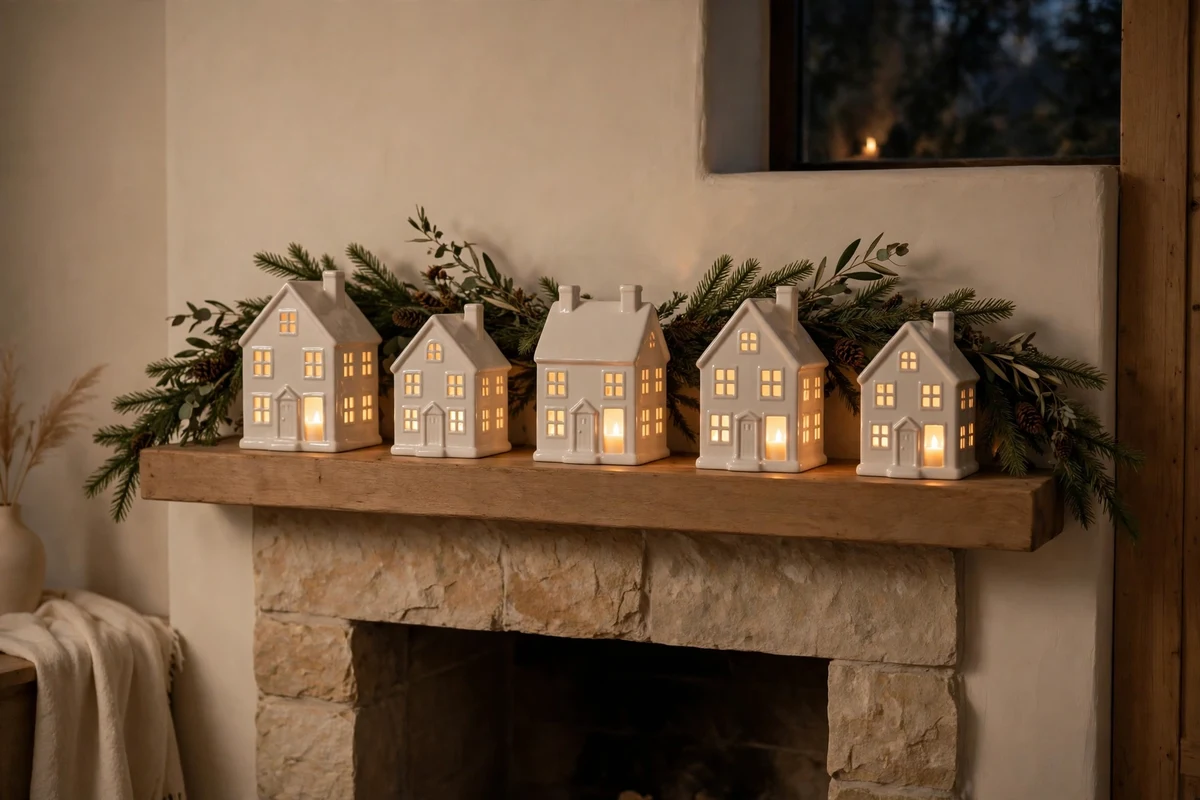
A neutral christmas mantel styling idea that never fails is a row of white ceramic houses, lit from within, along the mantel shelf. Mine are five little houses in different heights, all matte white, with warm lights glowing through their tiny windows, set among a simple fir garland and nothing else. In the evening the mantel looks like a tiny village at dusk, and it is the first thing I turn on when I come home in December. It costs little, it stores flat in a single box, and it has survived four moves without a single chip, which is more than I can say for most of my ornaments.
Style yours in a gentle rhythm: tall house, short house, tall house, with the garland tucked behind them rather than draped over them, so the houses stay the stars. I add one natural element — a pinecone or a sprig of fir laid flat — at each end, and nothing in the middle, because a mantel that is full from end to end feels like a shop display. Battery-operated houses with timers are worth every penny here: they switch themselves on at dusk and off at bedtime, so the village glows every evening without you remembering a thing. If your mantel already carries a mirror or art, keep the houses low and in front of it, so the reflection doubles the glow.
4. Beige Ornaments in Mixed Textures, Not Mixed Colours
Beige ornaments work when they mix textures, not colours: matte, velvet, glass, wood, and linen, all in the same quiet palette, so the tree has depth without a single loud note. My ornament box holds matte cream baubles, champagne glass drops, small wooden stars, linen-wrapped balls, and a few frosted glass icicles, and together they catch the light in five different ways. From a distance the tree reads as one calm colour; up close, it rewards a second look, which is exactly what elegant decorating should do. It is also the easiest ornament collection to build slowly, because every beige ornament you already own already matches.
Collect yours by texture rather than by set: one new texture each year, and the tree grows richer without ever changing colour. I hang the matte baubles deep inside the branches, where they give the tree body, and the glass and frosted pieces at the tips, where they catch the light. Wood and linen ornaments go at eye level, where their handmade feeling can be appreciated. If a bauble breaks — and one always does — a beige replacement is easy to find in any shop, which is a small mercy in December that coloured collections never offer.

5. Natural Wood Accents From Branch to Bowl
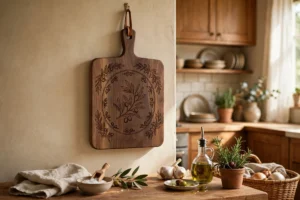
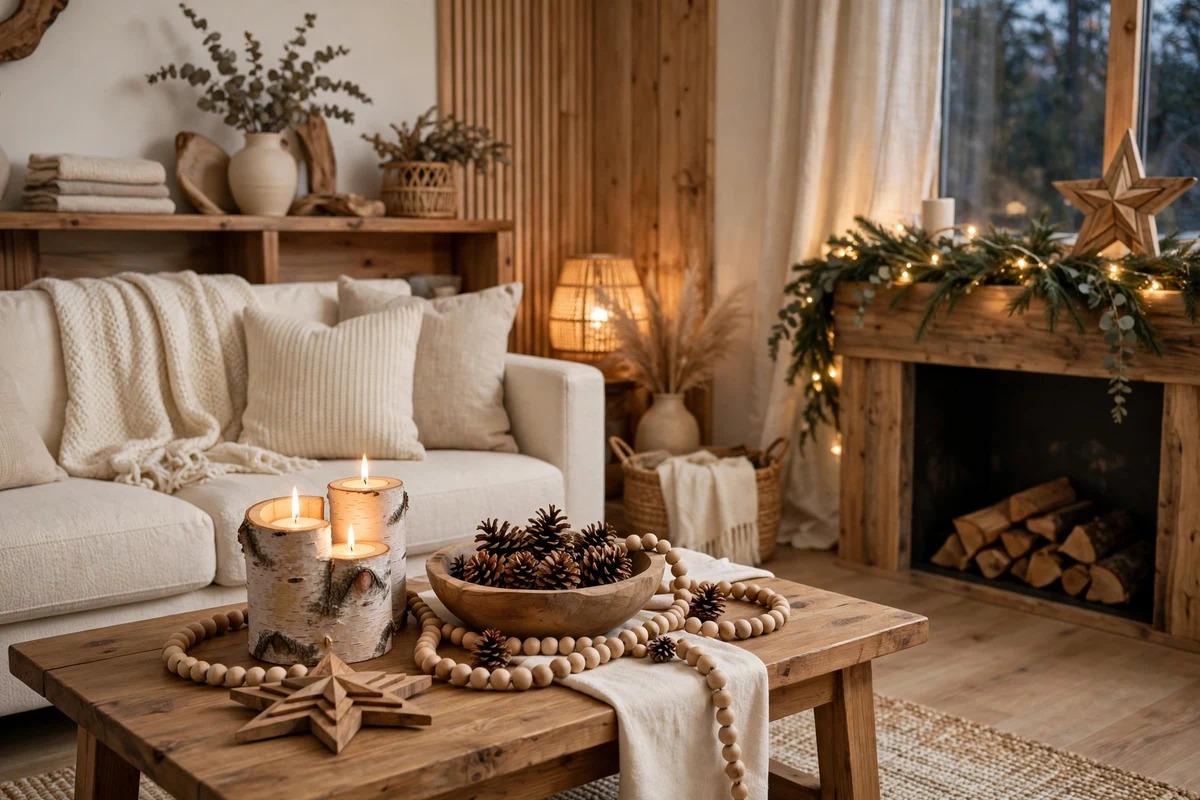
Natural wood accents are the backbone of neutral holiday decor, because wood adds warmth to a pale palette without adding a single colour. Mine appear everywhere in December: a birch log candle holder on the coffee table, wooden bead garland on the tree, a carved wooden star on top, a dough bowl of pinecones on the dining table, and wooden bead napkin rings at Christmas dinner. None of them shouts, and together they make the house feel grounded, like a cabin that happens to be in the suburbs. Wood is also the most forgiving material at Christmas — a scratch reads as character, not damage.
Start with one large wooden piece, a bowl or a tray, and let smaller wooden accents echo it around the house. I found my dough bowl at a car-boot sale for almost nothing, and it is the single most used decoration I own — pinecones in December, lemons in summer, keys the rest of the year. Mix the wood tones slightly — pale birch beside darker walnut — or the house will feel like a furniture showroom. If your tree already carries a wooden star, echoing the same wood on the mantel ties the rooms together without any effort at all, and guests will feel the connection even if they cannot name it.
6. A Linen Table Runner and White Ceramic Houses at Dinner
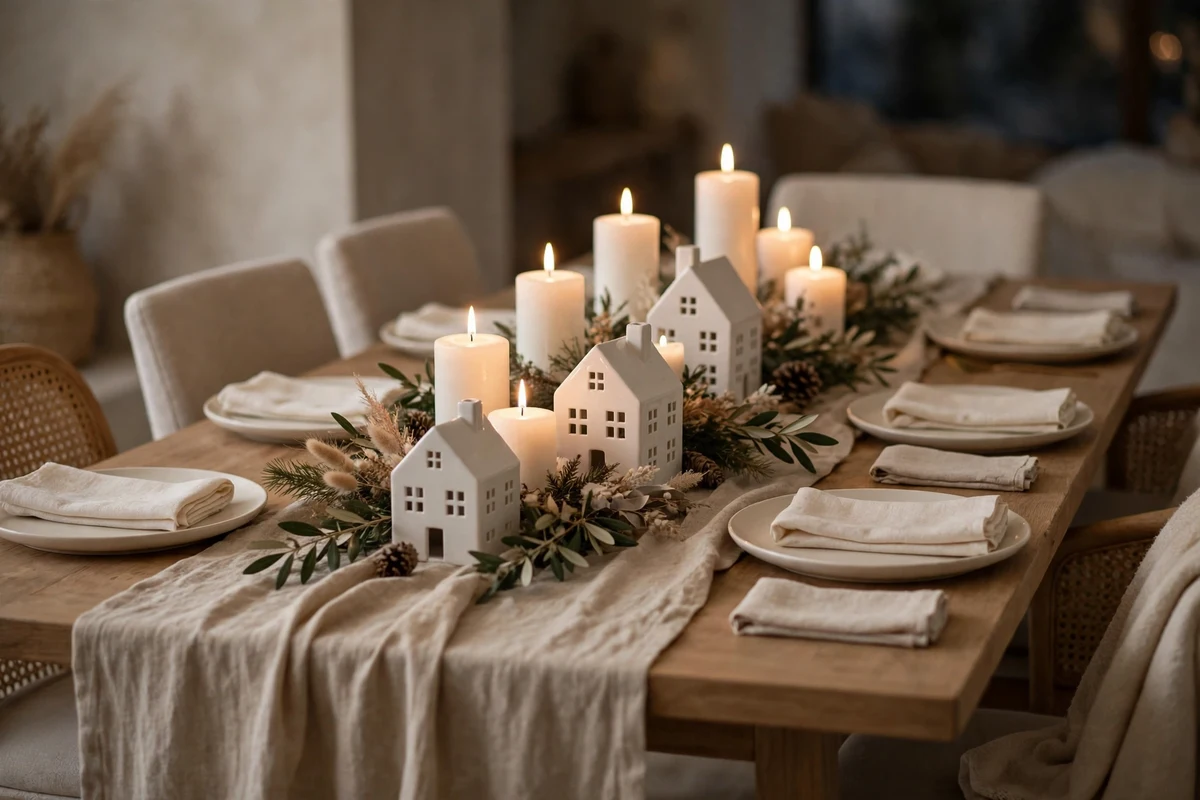
A linen table runner in natural flax is the foundation of a neutral christmas table, and mine has hosted every Christmas dinner for six years without ever looking tired. It goes down the middle of the table, slightly wrinkled — linen is supposed to wrinkle, and fighting it is a losing battle — with white ceramic houses or a row of pillar candles down its centre, and simple cream napkins at each place. The table looks expensive, it photographs beautifully, and it never competes with the food, which is, after all, the point of a dinner table. I have served everything from roast turkey to takeaway pizza on that runner, and it has made both feel like an occasion.
Choose a runner long enough to drape over both ends of the table, or it will look like a placemat that lost its way. I layer mine over a plain cream tablecloth for big dinners and use it alone for small ones, and both versions work. Keep the centrepiece low — houses, candles, or a short garland — so guests can see each other across the table, because a neutral table should serve conversation, not block it. If you want the same calm feeling on ordinary winter evenings, the runner stays out all December, and the house feels dressed even on nights when nobody is coming to dinner.
7. White Ceramic Houses on the Windowsill
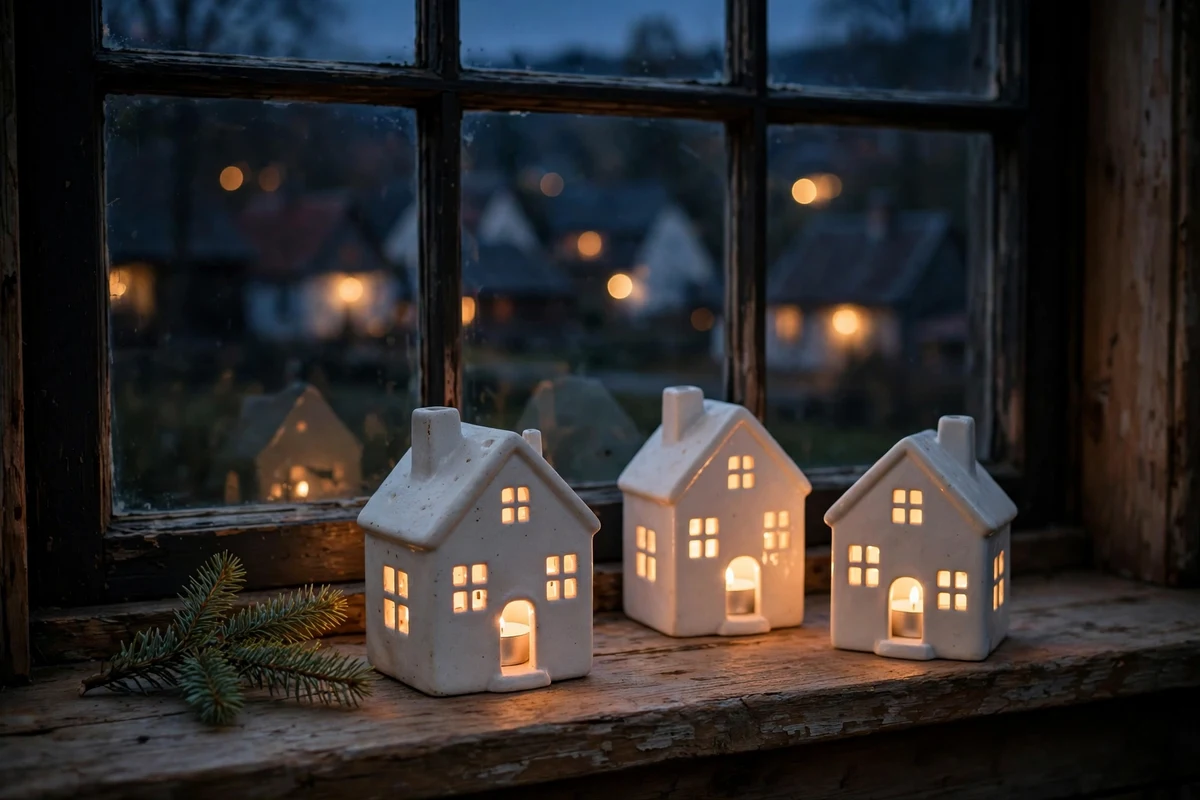
White ceramic houses belong on the windowsill as much as on the mantel, because from outside at dusk they turn an ordinary house front into a glowing village. Mine sit in a row along the front windowsill, three on one window and two on the other, lit from within, with a simple fir sprig laid beside them. Neighbours have stopped to look, and one asked where I bought the village, which is the highest compliment a decoration can receive. From inside, the houses frame the view with light, so even a dark December afternoon feels warm.
Use the same warm-white lights inside every house, or the village will look mismatched — cool white beside warm white reads as a mistake, not a choice. I keep the windowsill otherwise bare, because the houses need darkness around them to glow properly, and a cluttered sill swallows the effect. Battery houses with timers are essential here too, since nobody wants to climb behind curtains every evening. If your windows face the street, this is the single most effective neutral decoration you can buy, because it works for everyone who passes, not just for you.
8. A Frosted, Barely-There Tree for Small Spaces
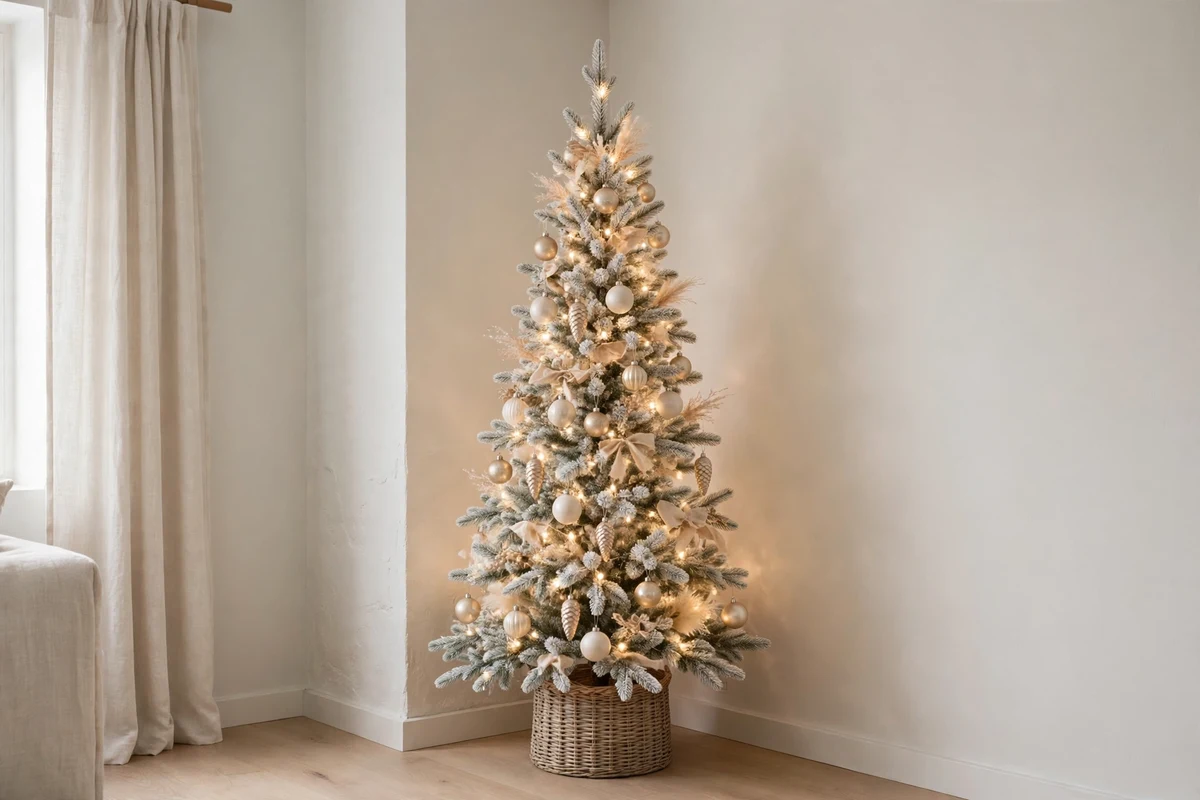
A frosted tree is the small-space answer to neutral holiday decor, because its pale branches already do half the styling work before a single ornament goes on. Mine, in my first flat, was a slim frosted tree barely taller than me, dressed in cream and champagne, and it made a tiny living room feel like a winter woodland rather than a crowded corner. The frost catches the lights and scatters them softly, so the tree glows even with very few ornaments, which is a mercy when storage space is also small. It is the tree I recommend to anyone decorating a flat, a bedroom, or a hallway corner.
Choose a slim or pencil profile if floor space is tight, and let the frost be the decoration — fewer ornaments, more lights. I used warm white lights only, wrapped generously, and about twenty ornaments in total, and the tree looked complete. Keep the base simple: a cream tree skirt or a woven basket, never a bright red stand cover, or the whole calm effect unravels. If your home already leans pale, a frosted tree disappears into the room in the loveliest way, glowing at dusk like something half-remembered from a childhood winter.
9. Eucalyptus and Dried Floral Picks on the Tree
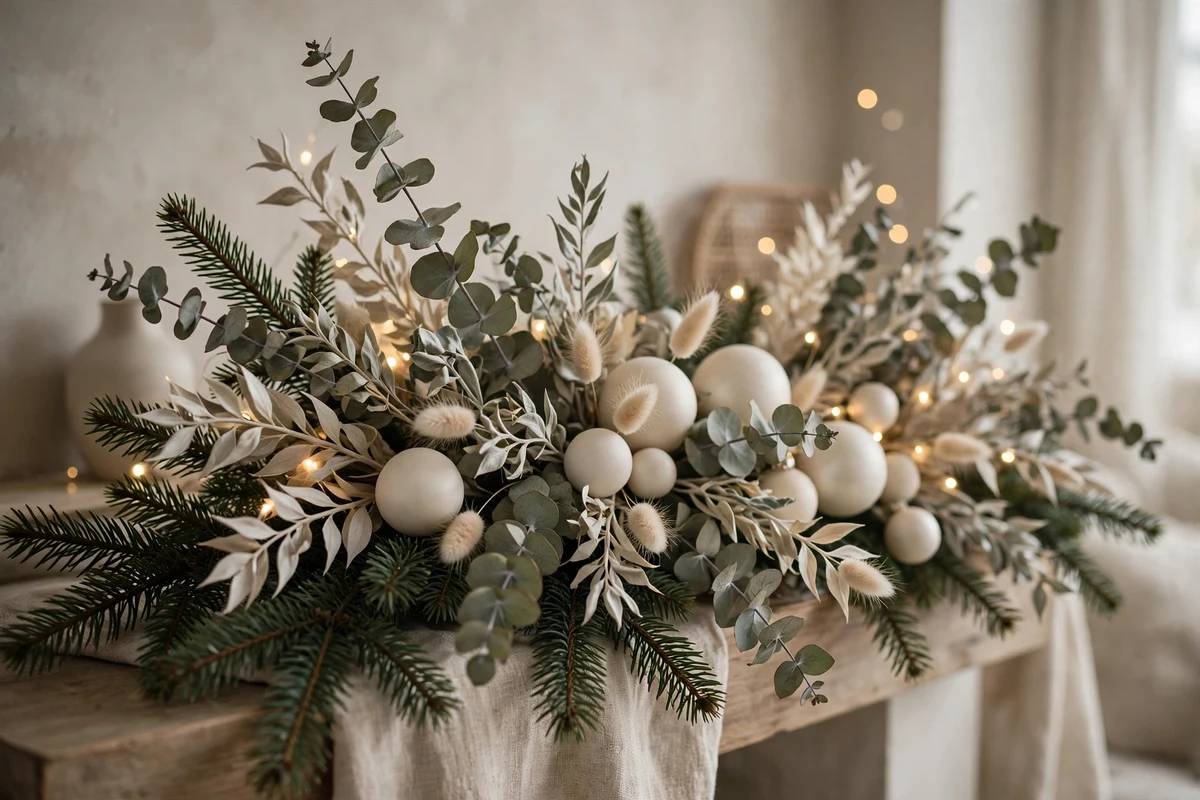
Eucalyptus and dried floral picks are the neutral tree’s answer to tinsel: soft, natural, and quietly beautiful, without a single strand of shine. Mine go into the tree in small bundles — a stem of dried eucalyptus, a bleached ruscus stem, a dried bunny tail or two — tucked into the branches between the ornaments, so the tree looks gathered from a garden rather than dressed from a box. They add a silvery-green tone that sits perfectly beside cream and champagne, and they smell faintly of the countryside every time I pass. It is the detail guests notice last and compliment most, which tells you it is the detail that matters.
Tuck the picks deep enough that they look grown into the tree, not stuck on top of it, and use odd numbers — three stems here, five there — because even numbers read as formal. I buy mine dried, never fresh, because fresh eucalyptus drops leaves all over the floor within a week, while dried stems last the whole season and into the next. If your mantel already carries a fir garland, echoing one eucalyptus stem in it ties the rooms together. The loveliest thing about dried picks is how they soften a tree of hard glass ornaments: green against cream, soft against shiny, and the whole tree feels alive.
10. A Neutral Wreath of Olive Branches and Cream Ribbon
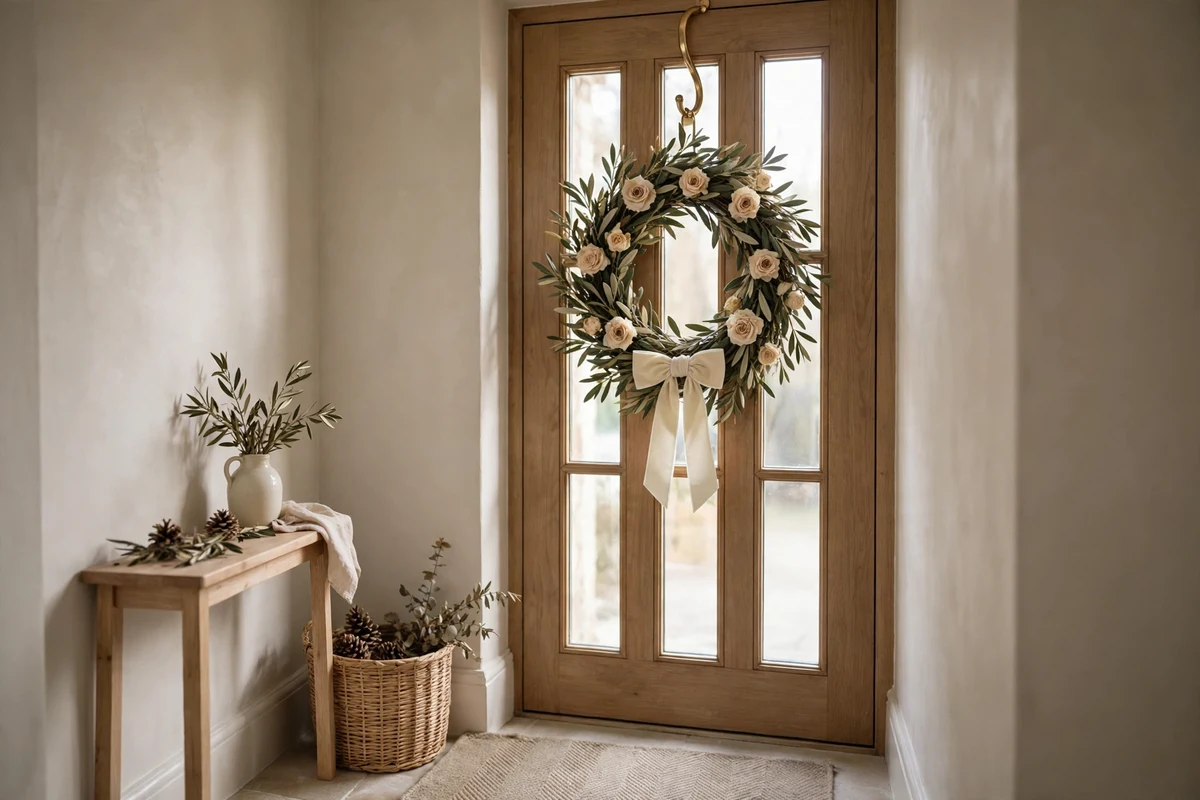
A neutral wreath made of olive branches and cream ribbon is the front door at its most elegant, and mine has replaced every red-and-green wreath I used to hang. It is a simple grapevine base, wired with olive branches for their soft grey-green leaves, a few dried cream roses tucked in, and one long cream velvet bow at the bottom. It looks expensive, it lasts the whole season without shedding, and it suits a front door of any colour, which is more than most wreaths can say. Visitors always touch it, which I take as proof that texture is the most welcoming thing a door can offer.
Build yours on a grapevine or moss base, because foam bases show through the moment a branch shifts. Wire the olive branches in small bundles, overlapping each bundle over the last one’s stems, and work all the way around before adding anything else — that is how you get fullness without bulk. Tie the bow separately and wire it on last, so you can remove it for storage without unpicking the whole wreath. I hang mine with a simple brass wreath hanger, because a neutral wreath deserves a quiet hook, not a glittery one. If your porch already carries lanterns, one olive wreath plus one lantern is the whole styling job, done.
11. Layered Linen and Knit Textures on Every Surface
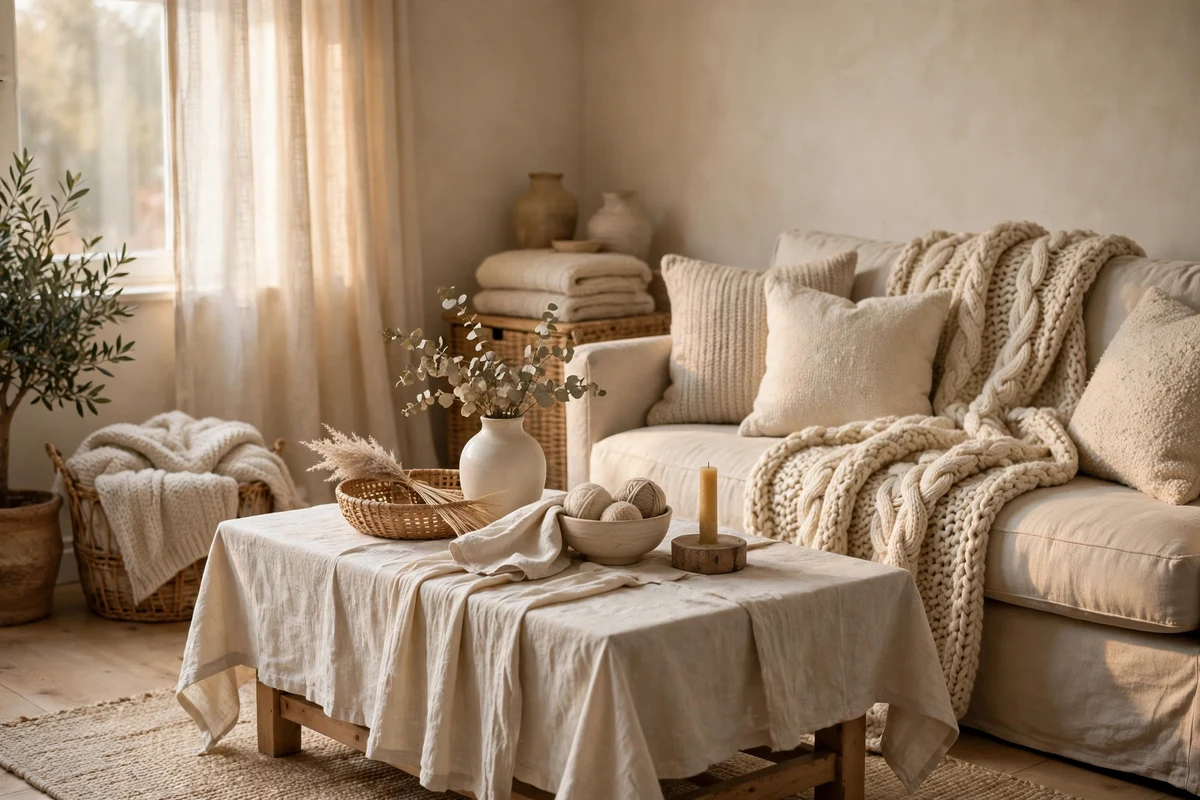
Layered linen and knit textures are what stop a neutral home from feeling empty, because in a pale palette, texture does the work that colour does elsewhere. My December house wears linen on the table, knit on the sofa, wool on the chairs, and a chunky knit throw folded on every seat that might hold a guest. The first time I sat down in the finished room on a cold evening, wrapped in all of it at once, I understood why people write about winter as a feeling rather than a season. Texture is not decoration here — it is warmth you can touch, and a pale room without it feels like a waiting room.
Start with the throw, because it is the layer you will actually use, and choose natural fibres over acrylic if you can — linen, wool, and cotton breathe, drape, and age beautifully, while acrylic pills and shines. I fold my throws rather than draping them artfully, because a throw that is folded is a throw that gets used. Add a cushion in a different texture — knit against linen, chunky against fine — so the layers feel collected rather than matched. If your sofa already wears a knit throw, echoing the same texture on the armchair ties the room together without a single new colour.
12. Warm White Lights Only, Everywhere
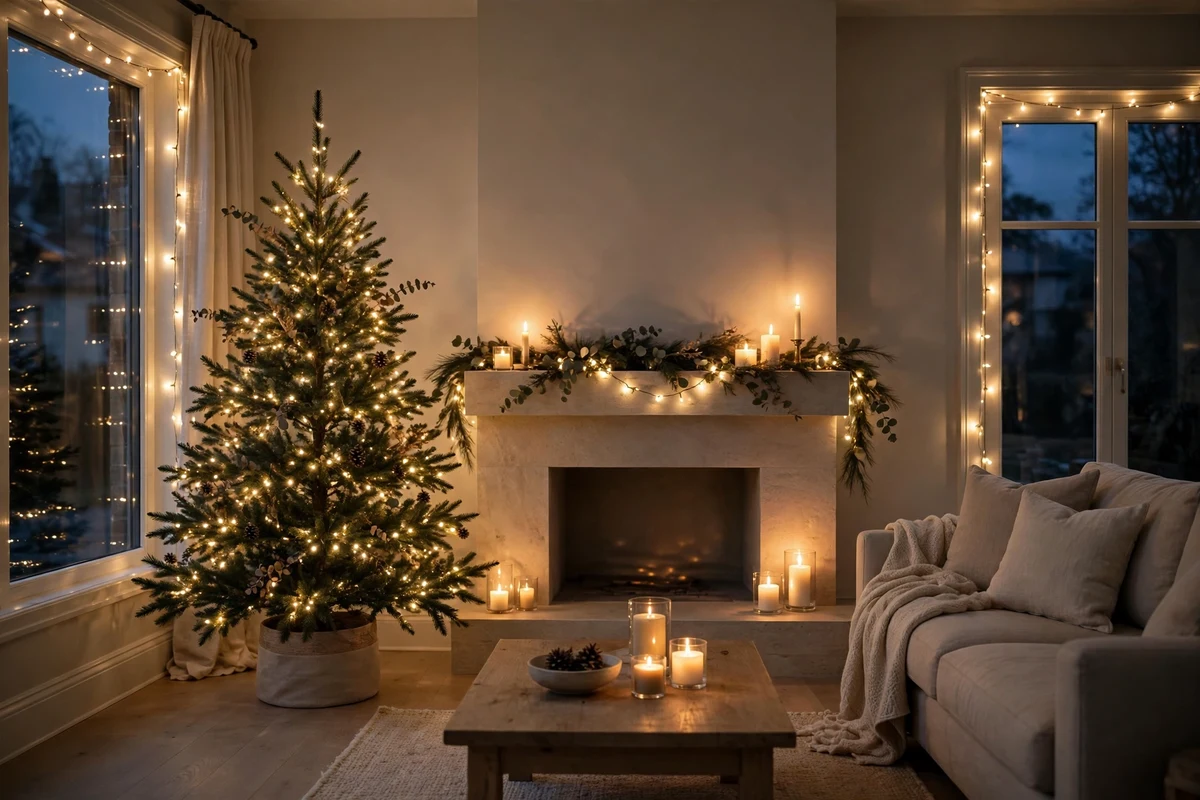
Warm white lights are the single rule that holds a neutral Christmas together, because one cool-white strand in a warm-white house reads as a mistake from across the room. Mine are warm white everywhere: on the tree, along the mantel, in the ceramic houses, around the windows, and in the lanterns on the porch. In the evening the whole house glows the same golden colour, like candlelight, and the effect is so calm that I leave the lights on later than I used to, just to sit in it. It is the cheapest rule in this article and the one I would keep if I had to give up everything else.
Check the label before you buy, because “white” on a box can mean cool, daylight, or warm, and shops shelve them side by side. I keep a spare strand of warm white in a drawer, because one failed strand in December is a small tragedy, and a matching replacement is a small mercy. Use timers wherever you can, so the house glows at dusk without you remembering, and keep the brightness low — a neutral house lit brightly feels like an office, while a neutral house lit softly feels like a poem. If your tree already glows warm white, matching the porch lights to it makes the whole house read as one intention, inside and out.
13. A Minimalist Neutral Holiday Table With One Statement Piece
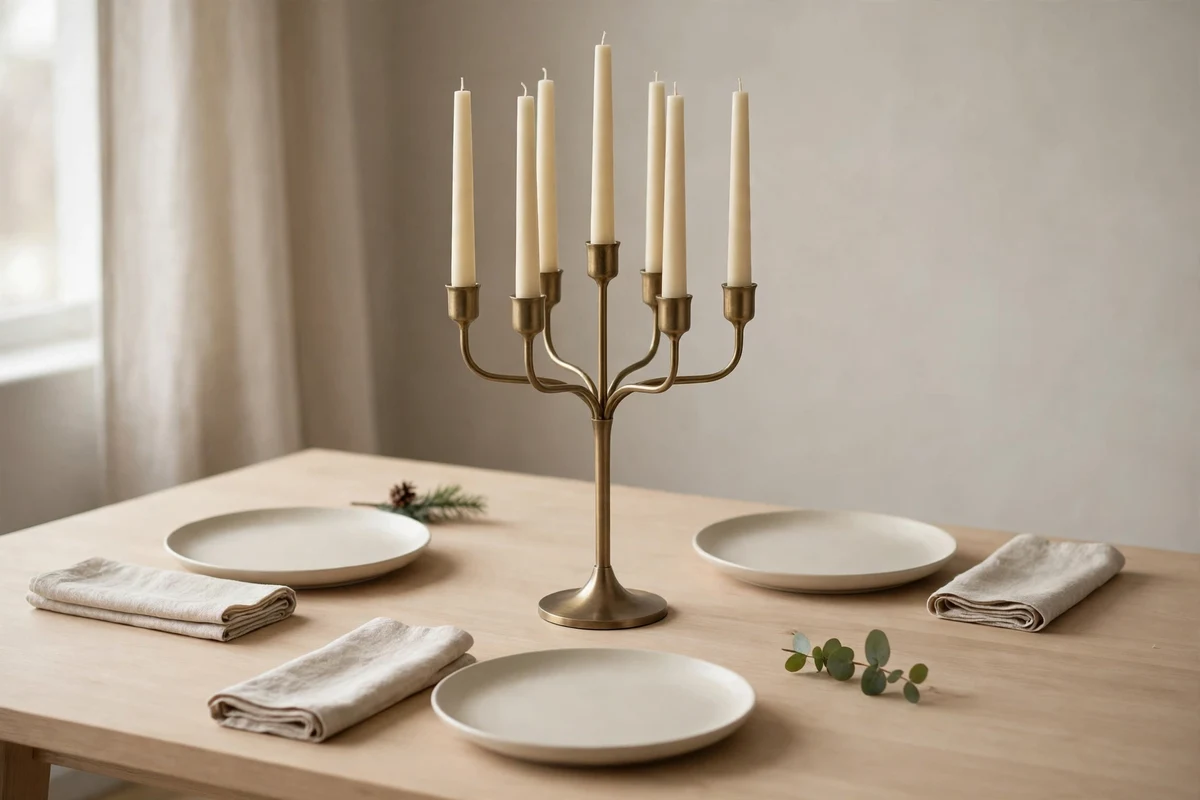
A minimalist neutral holiday table works when it has exactly one statement piece and nothing competing with it: mine is a tall, sculptural candelabra in matte brass, holding five cream taper candles, set in the middle of an otherwise bare linen-covered table. The candelabra does all the talking — its height, its brass glow, its five flames — while the plates, glasses, and napkins stay plain cream and quiet. Guests remember that table, because a table with one beautiful thing on it is more memorable than a table with twenty pretty things fighting for attention. It is also the easiest table I have ever set, which is a gift in a season of complicated things.
Choose your statement piece for height and simplicity: a candelabra, a sculptural vase of dried branches, or a single oversized lantern, never a collection of small objects. I keep everything else on the table plain — cream plates, clear glasses, linen napkins folded simply — so the statement piece has room to breathe. If you want the same calm feeling on the mantel, the rule holds there too: one beautiful object, well lit, beats a shelf of pretty things. The table should feel like a pause, not a performance, and one statement piece is how you get there.
14. Neutral Stockings in Linen, Knit, and Felt
Neutral stockings in linen, knit, and felt are the stocking answer for a calm Christmas, and mine hang in a row along the mantel in cream, oatmeal, and soft grey, each in a different texture. They look like they belong together without matching, which is the whole trick of neutral decorating: same family, different voices. Children in my house have claimed theirs by texture rather than by colour — the knit one, the linen one, the felt one — and that has become a small family language I love. They are also the easiest stockings to keep year after year, because a cream stocking never clashes with next year’s tree.
Hang yours from simple hooks or a plain mantel garland, never from glittery holders, or the calm effect unravels. I stuff the cuffs with a little tissue paper so they hold their shape, and I embroider initials in a matching thread rather than a contrasting one, so the personalisation whispers instead of shouts. If your mantel already carries ceramic houses, the stockings hang below them beautifully, like the village’s washing line. A neutral stocking filled with small, thoughtful gifts feels more generous than a loud one filled with noise, because the gifts, not the packaging, do the talking.

15. A Calm, Clutter-Free Entryway for Holiday Guests
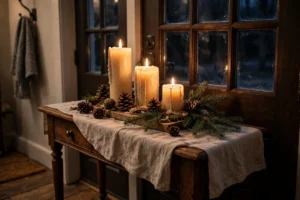
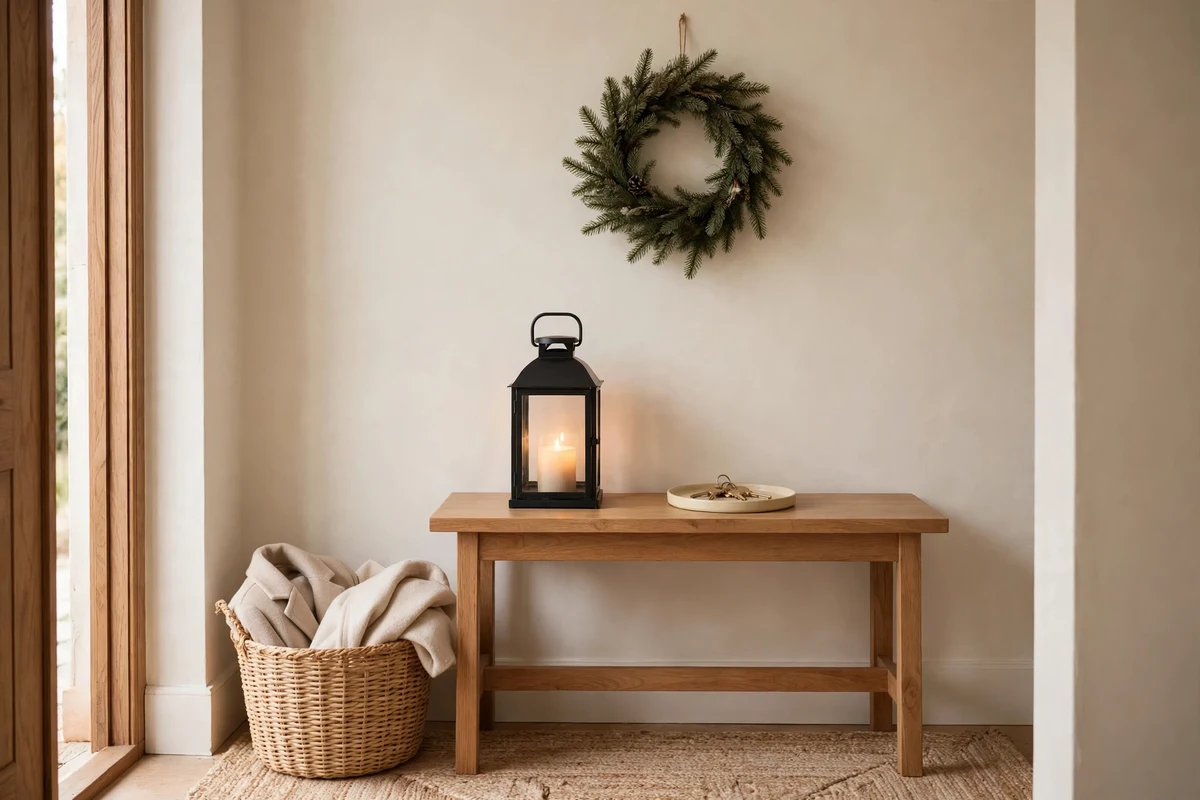
A calm, clutter-free entryway is the last neutral holiday idea and the first thing your guests actually see, so it deserves the same care as the tree. Mine in December holds exactly four things: a woven basket for coats, a tray for keys and gloves, a lantern with a warm candle on the console, and a small fir wreath on the wall. Everything else — the post, the school bags, the dog lead — lives behind a closed door for the season, and the hallway feels like a deep breath before the house itself. It is the simplest change in this article, and the one my guests compliment most, because a calm entryway makes the whole house feel calm, whatever waits beyond it.
Clear yours in one pass: everything that does not serve a guest coming in from the cold goes behind a door, and what remains gets one basket, one tray, and one light. I keep a folded cream throw on the basket for guests who are cold, which is a small kindness that costs nothing and is remembered. If your entryway already feels crowded, the rule is ruthless but simple: one object in, one object out, all December. When the door opens on a dark evening and the hallway glows warm and quiet, your guests relax before they have taken off their coats, and that is the whole point of a neutral Christmas — not less festivity, but festivity that lets people breathe.
Our Cozy Conclusion
A neutral holiday home asks very little of you: a cream ribbon, warm white lights, natural wood, linen textures, and the courage to leave things out. In return it gives you the calmest Christmas of your life — a house that glows rather than shouts, feels bigger than it is, and lets the people in it be the colour. Start with one idea, the tree or the mantel or the wreath, and let the rest follow year by year, as mine did. This December, turn off the overhead lights, light the candles and the tree, and sit for a while in the glow. The calm is the celebration.
You May Also Like
Scandinavian Christmas Decor Ideas — calm, cozy Nordic styling – Sage Green Christmas Tree Ideas — soft, serene tree styling – Farmhouse Christmas Decor Ideas — warm, gathered country styling
FAQs
What is neutral holiday decor?
Neutral holiday decor is Christmas styling in beige, cream, white, and natural wood, using texture, candlelight, and greenery instead of bold colour. It feels calm and elegant, suits any home, and never clashes with your everyday furniture.
How do you make a neutral Christmas tree look festive, not bare?
Layer textures and lights: warm white lights deep in the branches, cream velvet ribbon, and ornaments in mixed textures like matte, glass, wood, and linen. The tree looks rich because of texture and light, not because of colour.
What colours go with neutral holiday decor?
Beige, cream, ivory, oatmeal, champagne, soft grey, and natural wood tones, with one soft accent like sage green or muted gold if you want it. Avoid bright red, emerald, and glitter, which break the calm palette.
Can neutral holiday decor work in a small home?
Yes — it works especially well in small homes, because pale colours and warm light make rooms feel bigger. A slim frosted tree, a wreath, and warm white lights are enough to make a small space feel fully festive.
What lights are best for neutral Christmas decor?
Warm white lights only, on the tree, mantel, windows, and porch, all in the same warm tone. Cool white or multicoloured lights break the calm palette and make the house look mismatched.
How do you keep neutral decor from looking boring?
Mix textures generously: velvet ribbon, linen runners, knit throws, wooden beads, ceramic houses, and dried florals. Texture is what gives a pale palette its depth, so a room with five textures never looks flat.